
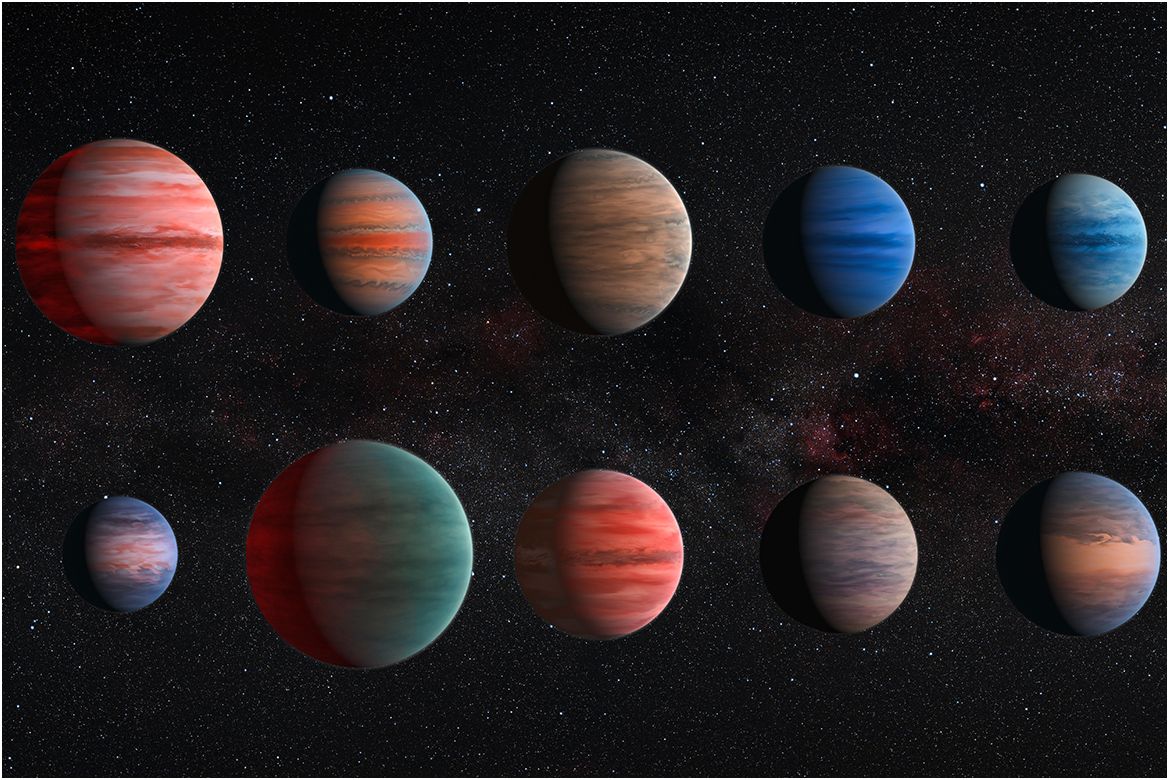
TOI-2535 b is an exoplanet known to be the first formerly transiting exoplanet. This exoplanet belongs to the category of “hot Jupiters”, planets with a mass similar to that of Jupiter, but which orbit much closer to their host star than our own gas giant does. It completes a full orbit around its star in just 8.25 days.
Researchers studied on this planet numerous times over the course of seven years, not by observing it directly, but by watching it transit in front of its star, until the transit stopped appearing altogether. It isn’t an unsolved mistery, what happened is that the gravitational influence of a nearby planet tilted its orbit to such an extent that its transit is no longer visible. NASA’s TESS telescope discovered TOI-2535 b, by measuring small changes in the brightness of stars as a planet passes in front of them. TESS has examined that region of the sky numerous times, allowing researchers to determine thatthe transits of TOI-2535 b have never been regular. In fact, they noted that the transits would occur either early or late, with deviations of up to six hours. Furthermore, beyond this temporal variability, the planet’s passages in front of the star became increasingly brief and appeared ever closer to the edge of the stellar disk—until, eventually, they ceased to appear altogether.

But who is the second actor of this system? The second planet is likely another giant, with a mass similar to or greater than that of Saturn—a fact that would make this stellar system quite unusual, as it contains two giant planets in short-period orbits around the star. According to this theory, the two planets cause each other to wobble like a spinning top; consequently, each orbits the star at an oblique angle, eventually moving out of our line of sight when the oscillation disrupts the alignment. This discovery offers new insights on giant planets formation and how they can move towards their closest star.
References:
“A TESS Disappearing Act: The Vanishing Transits of TOI-2535 b“, The Astrophysical Journal Letters (2026), 1011, L60 – Samuel W. Yee, Erik A. Petigura, Rafael Brahm, Karen A. Collins, Gregor Srdoc, David W. Latham, Allyson Bieryla, Victoria DiTomasso, Thomas Henning, Andrés Jordán, Trifon Trifonov, Khalid Barkaoui, Phil Evans, Emmanuel Jehin, Mourad Ghachoui, Michaël Gillon, Eric Girardin, Felipe Murgas, Enric Palle, Adam Popowicz, Don J. Radford, Howard M. Relles, Richard P. Schwarz, Avi Shporer, Abderahmane Soubkiou, David Watanabe, Francis P. Wilkin e Carl Ziegler
Images: NASA/ESA


